nothing you do at home will dramatically speed up how fast hair grows out of your scalp. Growth rate is mostly set by genetics, age, hormones and health. What you can control is how healthy your scalp is and how much length you lose to breakage. Those two things decide whether your hair looks longer, thicker and stronger over the next six to twelve months.
These hair growth tips are built around that reality. Each tip tells you what to do, how often, who it helps most, and what the evidence actually says, so you can separate what works from what is just marketing. If you are worried about hair loss rather than slow growth, jump to the section on when to see a dermatologist.
In this guide:
- Start-here priority list for beginners
- How hair grows and how fast
- 15 tips, each with an evidence rating
- Tips by hair type and scalp type
- Growth vs length retention
- Slow growth, breakage, shedding or hair loss: how to tell
- A 30-day routine and realistic 30/60/90-day expectations
- Myths, what not to do, when to see a doctor, and FAQs
The 6 Tips That Matter Most
Fifteen tips can feel overwhelming. If you only do six things, do these:
- Eat enough overall, including protein, iron and zinc from food. Hair is built from the same nutrients as the rest of you.
- Treat your scalp like skin. Keep it clean, comfortable and free of flaking or irritation.
- Reduce breakage. Detangle gently, use conditioner, limit heat.
- Avoid tight styles that pull on your roots.
- Be patient and consistent. Hair responds over months, not days.
- Get persistent or sudden hair loss checked. Some causes are treatable, and earlier is better.
Everything else in this guide builds on these six.
How Does Hair Grow? Understand the Hair Growth Cycle

Each hair grows from a follicle in your skin, and every follicle runs on its own cycle with three main phases:
- Anagen (growth phase): Cells in the follicle divide and the hair lengthens. This phase lasts roughly 2 to 7 years on the scalp. Your maximum hair length is largely determined by how long your anagen phase lasts, which is mostly genetic.
- Catagen (transition phase): The follicle shrinks and growth stops. This lasts a few weeks.
- Telogen (resting phase): The hair rests for around three months, then sheds, and a new hair begins growing from the same follicle.
At any moment, most scalp hairs (roughly 85 to 90 percent) are in the growth phase and a smaller share are resting. That is why losing some hair every day is normal. Shedding about 50 to 100 hairs a day is typical, and it can look like more when hair is long or you wash less often and the hairs collect.
How Fast Does Hair Actually Grow?

On average, scalp hair grows about 1 centimetre (around half an inch) per month, or roughly 12 to 15 centimetres (5 to 6 inches) a year. Some people grow a little faster, some slower. Growth can vary with age, genetics, hormones, nutrition, illness and hair type.
Two things follow from this:
- No shampoo, oil or supplement can double that speed in a healthy person.
- Hair that seems to “never grow” is usually breaking at the ends as fast as it grows at the roots. That is fixable.
15 Hair Growth Tips That Support Healthier, Stronger Hair
Each tip has an evidence rating:
- Strong: supported by good clinical evidence
- Moderate: reasonable evidence or well-understood mechanism
- Limited: small or early studies, or mostly anecdotal
1. Eat a Balanced Diet with Enough Protein
Evidence: Strong for deficiency, moderate otherwise
Hair is made mostly of keratin, a protein. When the body is short on energy or protein, it prioritises vital organs and hair can shed more. Include protein at most meals (eggs, fish, poultry, dairy, lentils, beans, tofu, nuts). hair growth tips Eat iron-rich foods (red meat, lentils, spinach, chickpeas) with vitamin C foods to help absorption. Zinc comes from seeds, legumes, meat and whole grains.
How often: Daily. Who benefits most: People on restrictive or crash diets, vegetarians and vegans, people with heavy periods.
Watch out: Rapid weight loss and very low-calorie diets can trigger noticeable shedding a few months later.
2. Check for Nutrient Deficiencies Before Taking Supplements
Evidence: Strong that deficiencies matter, limited that supplements help people who are not deficient
Low iron (ferritin), vitamin D, zinc and thyroid problems can all be linked with shedding. The smart move is to test first, then treat what is actually low under a clinician’s guidance. Taking a random hair supplement when you are not deficient is unlikely to help.
Two cautions:
- Biotin deficiency is rare, and high-dose biotin can interfere with certain blood tests, including thyroid and heart tests. Tell your doctor if you take it.
- Too much of some nutrients is harmful. For example, excess vitamin A is linked with hair loss, and too much zinc or selenium can cause problems.
Who benefits most: Anyone with ongoing shedding, heavy periods, a restricted diet or digestive conditions that affect absorption.
3. Keep Your Scalp Clean and Comfortable
Evidence: Moderate
Your scalp is skin. Heavy build-up, oiliness, dandruff or inflammation can irritate follicles and make you scratch, which damages hair. Wash often enough that your scalp feels comfortable, not itchy, greasy or flaky. If dandruff persists, use an anti-dandruff shampoo (ingredients such as zinc pyrithione, ketoconazole or selenium sulfide are commonly used) following the label.
How often: See tip 4. Who benefits most: Anyone with an itchy, flaky or oily scalp.
4. Choose Shampoo for Your Scalp Type, Not for a Fixed Schedule
Evidence: Moderate
There is no universal washing schedule. It depends on your scalp oil, hair texture, lifestyle and style.
| Scalp / hair type | Typical wash frequency | Notes |
|---|---|---|
| Oily scalp, fine hair | Every 1 to 2 days | Use a gentle, clarifying-leaning shampoo; focus on the scalp |
| Normal scalp, straight or wavy | Every 2 to 4 days | Adjust to comfort |
| Dry scalp or dry hair | Every 3 to 5 days | Use a hydrating, sulfate-free option if it suits you |
| Curly or coily hair | Roughly weekly to every two weeks, with co-washing or rinsing in between | Coily hair is more fragile and dries out faster |
| Sensitive or flaky scalp | As advised by a dermatologist | Use fragrance-free products |
These ranges are starting points, not rules. Shampoo mainly on the scalp, and let the suds rinse down the lengths.
5. Condition Hair to Reduce Breakage
Evidence: Strong for reducing breakage
Conditioner does not make hair grow, but it makes hair slippery and flexible, so it snaps less during washing and brushing. Apply conditioner mainly from mid-lengths to ends, leave it on for the time stated on the label, and rinse. Once a week, use a deeper mask or leave-in treatment if your hair is dry, coloured or heat-styled.
How often: Every wash. Who benefits most: Everyone, especially long, curly, coily, coloured or heat-damaged hair.
6. Massage Your Scalp Gently
Evidence: Limited but promising
Small studies suggest regular scalp massage may make hairs a little thicker over time, possibly by stretching follicle cells. The evidence is early. Massage is low-risk and relaxing, so it is worth trying if you enjoy it. Use your fingertips (not nails) in small circles for 3 to 5 minutes, ideally while shampooing.
How often: Daily or a few times a week. Caution: Be gentle. Aggressive rubbing can irritate the scalp or tangle long hair.
7. Limit Heat Styling and Use Heat Protection
Evidence: Strong for reducing damage
Flat irons, curling irons and hot blow-dryers weaken the hair shaft over time. Heat damage causes breakage, which makes growth look stalled.
- Air-dry or use a low or medium heat setting when you can.
- Apply a heat protectant before styling.
- Do not go over the same section repeatedly.
- Give your hair heat-free days each week.
8. Avoid Tight Hairstyles That Pull on the Roots
Evidence: Strong
Repeated tension from tight ponytails, braids, buns, weaves or extensions can cause traction alopecia, a form of hair loss that can become permanent if the pulling continues for years. Choose looser styles, vary where you place ponytails, avoid sleeping in tight styles, and take breaks from extensions. If your scalp feels sore or you see thinning at the hairline, loosen or remove the style and speak to a dermatologist.
9. Detangle Gently, Starting at the Ends
Evidence: Moderate (mechanical breakage is well understood)
Most breakage happens when hair is wet and being yanked through knots.
- Apply conditioner or a detangling product.
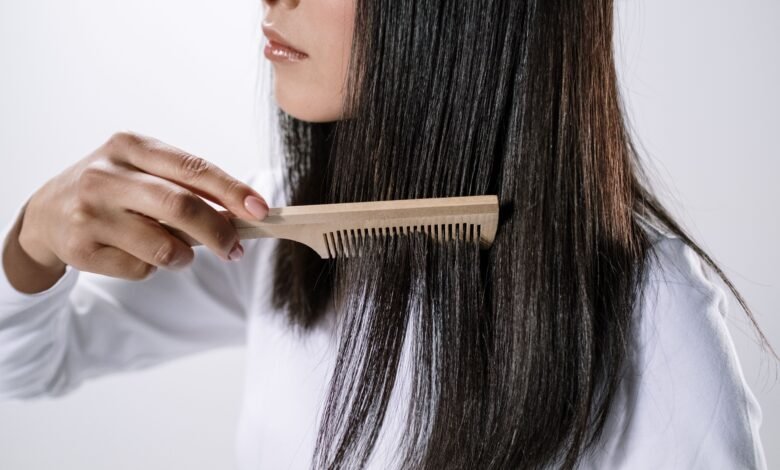
- Use a wide-tooth comb or a detangling brush.
- Start at the ends, work up in small sections, and finish at the roots.
- Never force a comb through a knot. Loosen it with your fingers first.
How often: Every time you comb. Who benefits most: Long, curly, coily and fine hair.
10. Protect Hair During Sleep
Evidence: Limited, but friction reduction is sensible
Friction against a cotton pillowcase can roughen hair, especially long or textured hair. A silk or satin pillowcase, or a satin bonnet or scarf, may reduce friction. It is a low-cost habit that helps with retention, not a growth booster. Keep the covering loose so it does not pull at your hairline.
11. Reduce Chemical and Colouring Damage
Evidence: Strong that chemical processing weakens hair
Bleaching, relaxers, perms and repeated colouring change the structure of the hair shaft and make it more fragile.
- Space out chemical treatments as much as you can.
- Avoid overlapping bleach or relaxer onto already-processed hair.
- Have strong processes done by a professional, and patch-test as the product instructs.
- Use extra conditioning and bond-repair treatments if your hair feels rubbery or snaps when wet.
12. Trim Split Ends to Help Retain Length
Evidence: Strong for length retention, none for faster growth
Trimming does not make hair grow faster, because growth happens at the root. But once a hair splits, the split can travel up the shaft. A small trim every 8 to 12 weeks (or when you see splits) removes damage before it climbs, so you keep more total length over time.
13. Manage Stress and Prioritise Sleep
Evidence: Moderate
Major physical or emotional stress, illness, surgery, childbirth or a high fever can push many hairs into the resting phase at once. About two to three months later, you may notice heavy shedding, a condition called telogen effluvium. It is usually temporary, and hair typically recovers once the trigger passes. You cannot remove all stress, but regular sleep, movement, and realistic rest help your body, and your hair, recover.
14. Use Oils for Conditioning, Not Guaranteed Regrowth
Evidence: Limited
Oils such as coconut, argan, olive or jojoba can soften hair, reduce friction and protect the hair surface. That helps with breakage. There is no good evidence that castor oil or most other oils make hair grow faster. Rosemary oil has shown some promise in a small study, but the evidence is early and it is not a proven treatment.
- Apply a small amount to the lengths and ends, not heavily on an oily scalp.
- Never apply undiluted essential oils to the scalp. They can cause irritation or allergic reactions. Dilute them in a carrier oil and patch-test first.
- If your scalp is prone to dandruff or breakouts, heavy oiling can make it worse.
15. Seek Evidence-Based Treatment for Persistent Hair Loss
Evidence: Strong for specific, diagnosed conditions
If hair is thinning, shedding heavily for months, or falling out in patches, no routine tip will fix an underlying cause. A dermatologist can identify the cause, whether it is hormonal, nutritional, autoimmune, scalp-related or genetic pattern hair loss, and discuss treatments.
Some treatments, such as topical minoxidil, have good evidence for pattern hair loss, but they need the right diagnosis, realistic expectations and sometimes months of use. Minoxidil can cause temporary shedding early on and is not suitable for everyone. Prescription options need a clinician. Do not self-prescribe.
A word on newer options:
- Red light or laser devices: Some have evidence in pattern hair loss, but results are modest and vary by device.
- Dermarolling or microneedling at home: Evidence for hair growth is limited, and poor technique or unclean tools can cause infection and scarring. Speak to a dermatologist before trying it.
Hair Growth Tips for Different Hair Types and Scalp Conditions
Straight and fine hair
Fine hair gets greasy faster and breaks easily when brushed wet. Wash more often if you need to, use lightweight conditioner on the ends, and avoid heavy oils that weigh hair down.
Wavy and curly hair
Curls need moisture. Detangle only with conditioner in your hair, use a wide-tooth comb or fingers, and avoid brushing dry curls, which causes frizz and breakage.
Coily and textured hair
Coily hair is naturally drier and more fragile because natural oils travel slowly down the bend of each strand. Wash less often but moisturise regularly, detangle gently in sections, protect ends with low-tension protective styles, and avoid tight braids, weaves or extensions that pull on the scalp. Handle gently, and prioritise length retention.
Oily scalp
Wash more regularly with a gentle shampoo, apply conditioner only to the lengths, and avoid layering heavy oils at the roots.
Dry or flaky scalp
The cause matters. Dry skin and dandruff look similar but need different care. If a mild anti-dandruff shampoo does not help after a few weeks, see a dermatologist.
Sensitive scalp
Choose fragrance-free products, patch-test anything new, and stop using anything that burns or stings.
Postpartum, post-illness or post-diet shedding
Heavy shedding a few months after pregnancy, illness or crash dieting is common and usually temporary. Eat well, be gentle with your hair, and speak to a doctor if it lasts beyond about six months or comes with other symptoms.
Hair Growth vs Hair Length Retention: What Is the Difference?
This is the missing piece in most hair advice.
- Hair growth is how fast new hair emerges from the follicle. You cannot change this much.
- Length retention is how much of that new hair you keep. You can change this a lot.
Imagine your hair grows about 1 cm a month, but the ends break off at roughly the same rate. Your length will look unchanged. Reduce the breakage and the same growth suddenly shows. That is why gentle handling, conditioning, protection from heat and tension, and regular small trims are the most reliable way to get longer-looking hair.
Slow Growth, Breakage, Shedding or Hair Loss: How to Tell the Difference
This is a self-observation guide, not a diagnosis.
| What you notice | It may suggest | What to do |
|---|---|---|
| Hair is healthy at the roots but won’t get past a certain length, with rough or split ends | Breakage and length retention issues | Gentle handling, conditioning, trims, less heat |
| Short broken pieces of hair in your brush, uneven lengths | Breakage | Same as above, review chemical treatments |
| Whole hairs with a small white bulb at the root, more than usual | Increased shedding | Think about recent illness, stress, diet or medication; see a doctor if it continues |
| Widening part, thinner ponytail, receding or thinning crown | Possible pattern hair loss | See a dermatologist |
| Round or oval patches of missing hair | Possible patchy hair loss | See a dermatologist soon |
| Sore, itchy, scaly or red scalp, with hair loss | Possible scalp condition | See a dermatologist |
A Simple 30-Day Hair Growth Routine
Every day
- Eat balanced meals with protein.
- Handle hair gently and avoid tight styles.
Every wash day (based on your scalp type)
- Shampoo the scalp with fingertips, massaging for 3 to 5 minutes.
- Condition mid-lengths to ends.
- Detangle with a wide-tooth comb from the ends upward.
- Use heat protectant if you style with heat.
Weekly
- Use a deep conditioning mask once.
- Take at least two heat-free days.
- Wash or replace your pillowcase or bonnet.
- Check your scalp for flaking, redness or soreness.
Week 1: Fix handling. Swap brushes, start conditioning, loosen styles. Week 2: Fix scalp care. Match shampoo to your scalp type and add massage. Week 3: Reduce damage. Cut back heat and plan any chemical treatments carefully. Week 4: Review. Book a trim if you have splits, and arrange a doctor visit if you are still worried about shedding.
Realistic Expectations: 30, 60 and 90 Days
- 30 days: Less breakage, softer hair, a calmer scalp. Not visibly longer.
- 60 days: Fewer split ends and a better feel. You may notice baby hairs at the hairline.
- 90 days: Around 3 cm of new growth, and noticeably better length retention if your habits are consistent.
- 6 to 12 months: The point at which healthy habits show clearly in overall length and thickness.
For medical treatments, results can take 3 to 6 months or longer to judge.
Common Hair Growth Myths You Should Know
“Trimming makes hair grow faster.” No. It prevents split-end breakage, which helps you keep length.
“Washing too much makes hair fall out.” Hairs you see in the drain were already shedding. Washing doesn’t cause loss, though harsh handling can cause breakage.
“Castor oil or onion juice will make hair grow rapidly.” There is no strong evidence for this, and some home remedies can irritate the scalp.
“Cold water seals the cuticle and boosts growth.” Water temperature does not change growth. Very hot water can be drying and irritating, so lukewarm is a comfortable choice.
“Biotin is a miracle growth vitamin.” It helps only in a true deficiency, which is uncommon, and it can interfere with some lab tests.
“Brushing 100 strokes a day makes hair healthy.” Excess brushing causes breakage. Brush gently when needed.
“Everyone can grow hair to waist length.” Maximum length depends on your growth phase, which varies by person.
What Not to Do
- Don’t take high-dose supplements without a reason or medical advice.
- Don’t put undiluted essential oils on your scalp.
- Don’t sleep or exercise in very tight styles.
- Don’t brush or comb wet hair roughly.
- Don’t copy a viral routine without checking the evidence.
- Don’t try at-home microneedling or prescription treatments without professional guidance.
- Don’t ignore sudden or patchy hair loss, hoping it will pass.
When Should You See a Dermatologist?
Book an appointment if you notice any of the following:
- Sudden or heavy shedding that lasts more than a few months
- Patchy hair loss or bald spots
- A widening part, receding hairline or visibly thinning crown
- A painful, itchy, red, scaly or burning scalp
- Hair loss along with fatigue, unexplained weight change, irregular periods, or other symptoms
- Hair loss after starting a new medication
- Breakage that does not improve after several months of gentle care
Early assessment matters, because some types of hair loss are easier to treat before follicles are permanently affected. Blood tests and a scalp exam can often find a cause.
FAQs About Hair Growth Tips
How can I make my hair grow faster naturally?
You can’t change your genetic growth rate much, but you can support healthy growth by eating a balanced diet, caring for your scalp, reducing breakage and avoiding tension on your roots.
How much does hair grow in one month?
On average about 1 cm (roughly half an inch). It varies by person.
What are the best hair growth tips for women?
The same fundamentals apply: balanced nutrition, checking iron and thyroid if you shed heavily, gentle styling, and getting persistent thinning assessed. Hormonal changes around pregnancy, menopause and conditions such as PCOS can affect hair, so see a doctor if you notice changes.
Which foods support healthy hair growth?
Mostly no. Oils can condition and protect hair, which reduces breakage, but strong evidence for faster growth is lacking.
Do hair oils actually make hair grow faster?
Mostly no. Oils can condition and protect hair, which reduces breakage, but strong evidence for faster growth is lacking.
How often should I wash my hair?
It depends on your scalp and hair type, from every day for oily scalps to once every one to two weeks for some coily hair.
Final Thoughts
Healthy hair growth is a slow game, and the winners are people who are consistent, not people who find the magic product. Look after your scalp, protect the hair you already have, eat well, and be patient for at least three months before judging results. If something feels off, such as sudden shedding, patches or a painful scalp, get it checked rather than guessing.