

What Are Classic Men’s Shoes?
Classic men’s shoes are timeless footwear styles that stay useful no matter how fashion changes. They include formal options such as Oxfords, Derbies and monk straps, as well as versatile choices such as loafers, brogues and simple leather boots. what are classic men’s shoes The right pair depends on the occasion, your outfit, the material, the fit and the level of formality you need.
In simple words: a classic shoe is one your father could have worn, you can wear today, and your son could still wear in twenty years without it looking dated.
That is the short answer. The rest of this guide gives you what most shoe articles skip: a clear way to judge any shoe, what are classic men’s shoes a side-by-side comparison, a formality ladder, fit and width advice, construction basics, care tips and a simple buying plan.
In this guide:
- What makes a shoe “classic”
- 10 classic styles, each explained the same way
- A comparison table and formality ladder
- Oxford vs Derby, and where brogues fit in
- Leather vs suede, construction and fit
- Care, budget, a 3-pair starter wardrobe and common mistakes
- FAQs and a plain-English glossary
What Makes a Men’s Shoe a Classic?
Not every popular shoe is a classic. Trends come and go in a season or two. A genuinely classic shoe usually passes five tests:
- Timeless silhouette. Clean, balanced proportions with no exaggerated toe shapes, oversized soles or loud branding.
- Functional design. Every feature has a purpose: lacing for adjustment, a stacked heel for stability, a leather sole for formal grace.
- Quality materials. Good leather or suede that ages well and can be repaired rather than thrown away.
- Versatility. It works with several outfits and more than one type of occasion.
- Longevity. It has stayed in use across decades, not just a few trend cycles.
A useful rule: if you can imagine the shoe looking right in an old film, in a modern office and at a wedding next year, it is probably a classic.
Classic Shoes Come in Two Families: Dress and Casual-Classic

Most guides blur this line, which confuses beginners. It helps to split classics into two groups.
- Dress classics: Oxford, Derby, monk strap, dressy brogue and dress boot. They are leather, slim and polished, and they suit suits and tailoring.
- Casual-classics: Loafer, Chelsea boot, chukka boot, boat shoe and minimal leather sneaker. They are relaxed, flexible and easy with chinos, denim and smart separates.
Some shoes sit in between. what are classic men’s shoes A sleek black loafer can dress up; a suede loafer dresses down. We will flag these cases below so you are never guessing.
10 Types of Classic Men’s Shoes

Every style below follows the same template so you can compare quickly: what it is, how to recognise it, formality, best occasions, outfit pairing and one honest limitation.
1. Oxford Shoes
What it is: The most formal everyday dress shoe. Its defining feature is closed lacing: the eyelet panels are stitched underneath the front part of the shoe (the vamp), so the laces sit neatly together with a sleek, narrow look.
How to recognise it: Closed lace opening, slim profile, low heel, usually a thin leather sole.
Formality: High.
Best for: Business formal, weddings, interviews, black-tie-adjacent events (in black, plain or cap toe).
Outfit pairing: Suits, tailored trousers, tuxedos in black patent or very polished black calf.
Limitation: The closed lacing gives less room, so Oxfords can feel tight on people with high insteps or wider feet.
Variations to know: Plain-toe (most formal), cap-toe (the business standard, what are classic men’s shoes with a horizontal toe cap), wholecut (cut from one piece of leather) and Balmoral, the traditional name for the closed-lace construction.
2. Derby Shoes
What it is: The Oxford’s more relaxed cousin. Derbies use open lacing: the eyelet panels are sewn on top of the vamp, so the sides can open wider.
How to recognise it: Visible flaps with the lace area sitting on top of the front of the shoe, giving a slightly chunkier look. In some regions, the term “Blucher” is used for a similar open-laced design.
Formality: Medium to medium-high.
Best for: The office, smart-casual events, dinners, travel days and anyone who wants all-day comfort.
Outfit pairing: Suits in less formal settings, chinos, tailored trousers, dark denim.
Limitation: A chunky or thick-soled Derby looks less formal than an Oxford, so it is not the best choice for the most formal events.
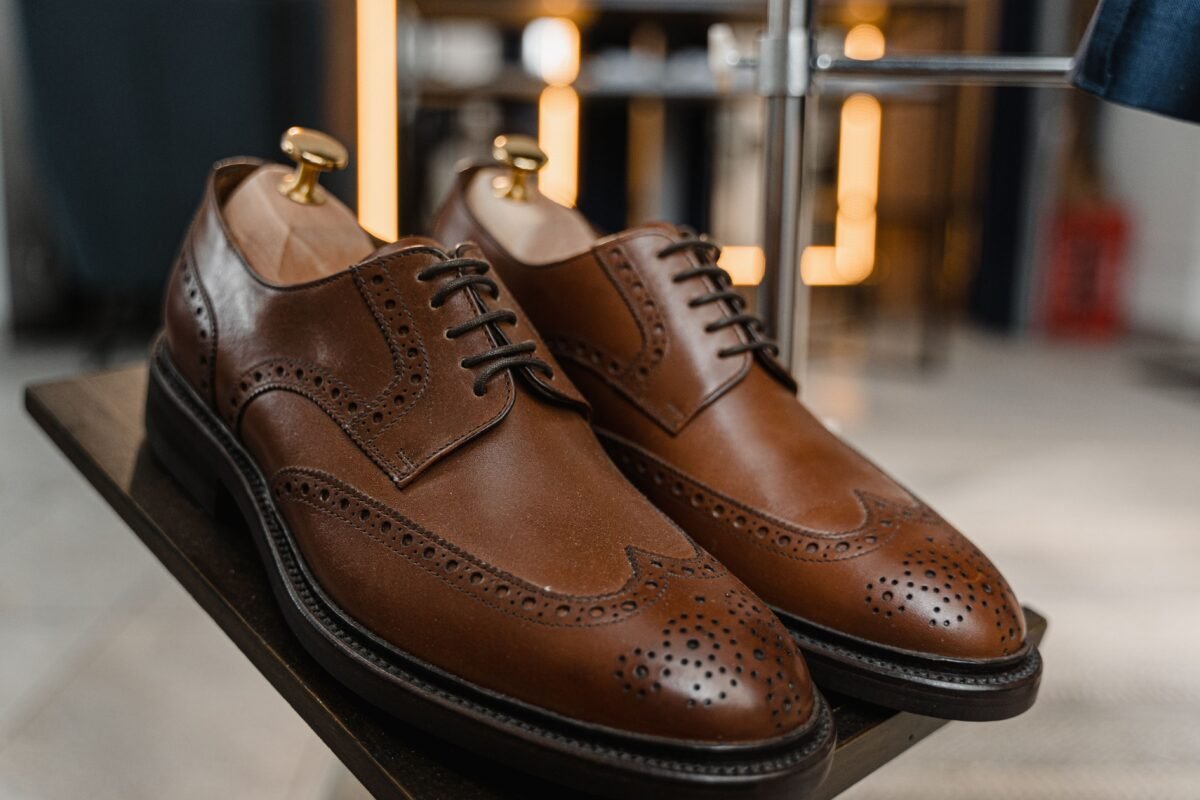
3. Brogue Shoes
What it is: A brogue is not a separate lacing type. It is a style of decoration: decorative perforations (small holes) and serrated edges on the leather. A brogue can be built as an Oxford or a Derby.
How to recognise it: Patterned punching along the seams or toe. Full brogues (wingtips) have a pointed toe cap that extends along the sides; what are classic men’s shoes semi-brogues have a cap with a punched pattern; quarter brogues have perforations only along the cap edge.
Formality: Depends on the amount of detail. The fewer the holes, the more formal. A quarter-brogue Oxford in black is business-ready; a full-brogue Derby in tan suede is relaxed.
Best for: Business casual, social events, countryside and weekend smart wear.
Outfit pairing: Tweed, flannel, chinos, textured jackets, smart knitwear.
Limitation: Heavily detailed brogues do not pair well with a sharp formal suit.
4. Monk Strap Shoes
What it is: A laceless dress shoe that closes with a buckle and strap across the instep. Single-strap and double-strap versions are both common.
How to recognise it: Buckle fastening, clean front, often a cap toe.
Formality: Medium-high. Plain black single monks can work in business settings, while double monks lean more fashionable.
Best for: Office wear, events, and anyone who wants a polished alternative to lace-ups.
Outfit pairing: Suits, tailored trousers, smart blazers with chinos.
Limitation: The buckle gives a stronger visual statement, so very conservative dress codes may prefer a plain Oxford.
5. Loafers (Penny and Tassel)
What it is: A slip-on shoe with no laces or buckles. The penny loafer has a leather strap with a small slit across the vamp. The tassel loafer adds decorative tassels.
How to recognise it: Low-cut, slip-on, moccasin-style construction with a flat leather or rubber sole.
Formality: Medium to relaxed. Black polished leather loafers can dress up; suede and woven versions are casual.
Best for: Smart casual, travel, warm weather, creative offices and relaxed events.
Outfit pairing: Chinos, linen trousers, unstructured jackets, tailored shorts (without socks, or with invisible socks, in summer).
Limitation: Poor fit leads to heel slip, and a loafer is rarely accepted at strictly formal events.
6. Chelsea Boots
What it is: An ankle-height boot with no laces. Elastic side panels let you pull it on, and a small pull-tab at the back helps.
How to recognise it: Smooth, minimal upper, elastic gusset on each side, rounded or slightly almond toe.
Formality: Medium. Sleek black leather Chelseas can look sharp with slim tailoring; suede or crepe-soled versions are casual.
Best for: Autumn and winter, creative or casual offices, evenings out.
Outfit pairing: Slim jeans, chinos, slim trousers, overcoats and leather jackets.
Limitation: Not ideal in heavy rain or snow unless the leather is treated and the sole has grip. Wider calves can find the opening tight.
7. Chukka Boots
What it is: An ankle boot with two or three pairs of eyelets, usually made from suede or soft leather. Desert boots are a close relative with a crepe sole.
How to recognise it: Short lace-up boot, low ankle, simple profile.
Formality: Medium to casual.
Best for: Weekends, relaxed offices, road trips, spring and autumn.
Outfit pairing: Chinos, denim, casual tailoring, knitwear and field jackets.
Limitation: Suede marks easily with water and stains, so it needs protection and a bit of attention.
8. Dress Boots
What it is: A refined lace-up boot made from polished leather, what are classic men’s shoes often with a welted sole. Think of an Oxford or Derby with more ankle coverage.
How to recognise it: Higher ankle, sleek leather upper, smoother finish than rugged work boots.
Formality: Medium-high.
Best for: Cold weather, winter commuting, smart outfits that need more protection.
Outfit pairing: Wool trousers, flannel suits, overcoats, dark denim.
Limitation: Heavier than low-cut shoes and not suited to hot climates or strict black-tie events.
9. Boat Shoes
What it is: A casual leather shoe with a moccasin-style upper, what are classic men’s shoes rawhide laces and a non-marking sole designed for grip on wet decks.
How to recognise it: Leather laces running through the sides and around the heel, thin siped rubber sole.
Formality: Casual.
Best for: Warm weather, holidays, weekends and relaxed social occasions.
Outfit pairing: Shorts, light chinos, linen shirts and polos.
Limitation: Limited support and a very casual look, so they do not belong in offices with a formal dress code.
10. Minimal Leather Sneakers
What it is: A clean, low-profile sneaker in smooth leather with minimal branding. It is the boundary case between a classic and a casual trainer.
How to recognise it: Simple silhouette, plain or tonal sole, no loud logos or technical features.
Formality: Casual to smart casual.
Best for: Everyday wear, travel, relaxed offices and weekend outfits.
Outfit pairing: Jeans, chinos, casual jackets, knitwear.
Limitation: Not a dress shoe. Do not wear with a formal suit.
Why include it? Many modern wardrobes depend on a clean white or neutral leather sneaker. It earns a place when it is simple, well made and kept clean, and it stays out of any dress code that demands lace-ups.
Classic Men’s Shoes Compared at a Glance
| Shoe style | Formality | Best for | Outfit pairing | Comfort note |
|---|---|---|---|---|
| Oxford | High | Business formal, weddings | Suit, tailored trousers | Narrower fit |
| Derby | Medium-high | Office, smart casual, dinners | Suit, chinos, tailored trousers | Easier for wider feet |
| Brogue | Varies by detailing | Business casual, social events | Tweed, chinos, smart tailoring | Depends on base style |
| Monk strap | Medium-high | Office, events | Suits, tailored trousers | Adjustable via buckle |
| Loafer | Medium to relaxed | Smart casual, travel, summer | Chinos, linen, relaxed tailoring | Easy on and off |
| Chelsea boot | Medium | Autumn/winter, office casual | Jeans, chinos, slim trousers | Check calf and ankle fit |
| Chukka boot | Medium to casual | Weekends, relaxed office | Chinos, denim | Light and flexible |
| Dress boot | Medium-high | Cold weather, smart outfits | Wool trousers, suits | More support, heavier |
| Boat shoe | Casual | Warm weather, leisure | Shorts, chinos | Soft, little support |
| Minimal sneaker | Casual to smart casual | Everyday wear | Jeans, chinos | Very comfortable |
The Formality Ladder: Which Shoe for Which Dress Code?
Use this ladder when you are not sure what to wear. what are classic men’s shoes Go from the top (most formal) to the bottom (most casual).
- Black-tie and very formal events: Black plain-toe or wholecut Oxfords, polished. Patent leather is traditional for tuxedos.
- Business formal and weddings: Black or dark brown Oxfords, including cap toes.
- Business and smart office: Derbies, quarter-brogues, single monk straps, dress boots.
- Business casual: Brogues, loafers, Chelsea boots, brown Derbies.
- Smart casual: Suede loafers, chukkas, Chelsea boots, minimal leather sneakers.
- Casual and weekend: Boat shoes, desert boots, casual loafers, sneakers.
Quick colour rules: Black is the most formal; dark brown follows; tan and lighter shades are more casual; what are classic men’s shoes suede is almost always more casual than smooth leather in the same colour.
Oxford vs Derby: What Is the Difference?
This is the most-asked question in men’s footwear, and it comes down to one thing: how the lacing panels are attached.
- Oxford (closed lacing): The eyelet panels are stitched under the vamp. The shoe looks sleek and formal.
- Derby (open lacing): The eyelet panels are stitched on top of the vamp. The shoe opens wider, adjusts more easily and looks a little more relaxed.
Which should you buy first? If you wear suits often or need one shoe for formal events, choose a black cap-toe Oxford. what are classic men’s shoes If your life is mostly office, smart casual and travel, start with a dark brown Derby. Many men eventually own both.
Where brogues fit in: Brogue detailing can appear on either one. When someone says “brogue Oxford” or “brogue Derby”, they are combining decoration with lacing style.
How to Choose Classic Shoes for Your Wardrobe
To avoid buying shoes you rarely wear, work through these four questions.
- What do you wear most days? Suits point you towards Oxfords; chinos and jeans point you towards Derbies, loafers and boots.
- What is your climate? Warm cities favour loafers and light leather; cold or wet places benefit from dress boots, Chelseas and rubber or Dainite-style soles.
- What colours are in your wardrobe? Navy, grey and charcoal work with black or dark brown. Earthy tones, khaki and olive work well with brown, tan and suede.
- What is your budget per wear? A $250 pair worn 150 times costs less per wear than a $60 pair that falls apart after 30.
The 3-Pair Starter Wardrobe
If you are building from scratch, begin here:
- Pair 1: Dark brown Derby or brogue. The most flexible all-rounder for office and smart casual.
- Pair 2: Black cap-toe Oxford. For formal events, interviews and business formal dress codes.
- Pair 3: A casual-classic. A suede loafer, chukka or Chelsea boot, depending on your climate and lifestyle.
This trio covers most situations. what are classic men’s shoes Add a clean leather sneaker and a seasonal boot and you have a complete, practical shoe wardrobe.
Leather vs Suede: Which Material Should You Choose?
| Smooth leather | Suede | |
|---|---|---|
| Look | Polished, formal | Soft, textured, relaxed |
| Formality | Higher | Lower |
| Best seasons | Year-round | Spring, summer, dry autumn days |
| Care | Cream, polish, brush | Brush, protector spray, suede eraser |
| Weather tolerance | Better with care | Weak against rain and stains |
| Best for | Business, formal | Smart casual, weekends |
Beginner tip: Choose smooth calf leather for your first formal shoes and suede for a casual pair. what are classic men’s shoes Always treat suede with a protector spray before wearing it outside.
Construction Basics: What Should You Look For?
You do not need to be a shoemaker, what are classic men’s shoes but understanding how a shoe is built helps you judge quality and decide whether it can be repaired.
- Goodyear welted: A strip (the welt) is stitched to the upper and the sole is attached to it. It is durable and can be resoled many times. Usually found in mid-to-high-priced shoes.
- Blake stitched: The upper is stitched directly to the sole. It is sleeker and lighter, and can also be resoled, though less easily.
- Cemented: The sole is glued on. It is cheaper and lighter, but usually cannot be resoled easily.
- Leather quality: Full-grain leather is generally the best. “Corrected grain” and “bonded leather” are lower-quality options.
- Sole type: Leather soles look elegant but are slippery in the rain. Rubber or Dainite-style soles give more grip, and are better for wet weather.
A good question to ask in a shop: what are classic men’s shoes “Can this shoe be resoled?” If the answer is yes, it is likely a better long-term investment.
How Should Classic Men’s Shoes Fit?
Fit matters more than brand. A beautiful shoe that hurts will stay in the cupboard.
The five-point fit check:
- Length: About a thumb’s width (around 1 cm) between your longest toe and the front of the shoe when standing.
- Width: The ball of your foot should feel held, not squeezed. Look for brands that offer width options if standard sizes feel tight.
- Heel: It should hold firmly, with only slight movement when you walk. Heavy slipping means the shoe is too big or the shape is wrong for you.
- Instep: Laces should close without strain. If you have a high instep, Derbies often feel better than Oxfords.
- Toe box: Toes should lie flat without rubbing the top or sides.
Smart fitting habits:
- Try shoes on in the late afternoon, when feet are slightly larger.
- Wear the socks you plan to use with them.
- Measure both feet, since one is usually larger. Fit the bigger one.
- Walk around on a hard floor, not just carpet.
- Expect leather shoes to soften slightly after a few wears, but never buy shoes that hurt on day one.
Sizing note: Sizes vary between brands and countries what are classic men’s shoes (UK, US and EU systems differ). Always check each brand’s size chart and return policy before ordering online.
How to Care for Classic Men’s Shoes
Good shoes can last for years with a simple routine.
After every wear:
- Insert cedar shoe trees to absorb moisture and keep the shape.
- Brush off dust with a horsehair brush.
Every few weeks (or after about 8 to 10 wears):
- Clean with a damp cloth, then apply a leather conditioner or cream.
- Use matching wax polish to restore colour and add a protective layer.
- Buff with a soft cloth or brush.
Rotation rule: Avoid wearing the same pair two days in a row. Leather needs about 24 hours to dry from foot moisture.
When shoes get wet: Let them dry naturally, away from direct heat, with shoe trees or paper inside. Heaters and hairdryers crack leather.
Resoling: Replace the sole before it wears all the way through, especially on welted shoes. what are classic men’s shoes A cobbler can often add new heels and soles at a fraction of the price of a new pair.
Common Mistakes When Buying and Wearing Classic Shoes
- Buying a trendy shape and calling it classic. Extreme toe shapes and chunky soles date quickly.
- Wearing brown shoes with a black belt (or vice versa). Match belt and shoe tone for a cleaner look.
- Ignoring socks. Wear socks that match your trousers or complement your shoes. Avoid short white sports socks with dress shoes.
- Wearing suede to a wet day out. Choose treated leather or rubber soles instead.
- Skipping shoe trees. Creases deepen and the shape collapses faster.
- Choosing the wrong formality. A boat shoe at a wedding or a heavy brogue with a sharp business suit looks off.
- Buying for looks only. Check comfort, fit and repairability.
Frequently Asked Questions
What are classic men’s shoes?
Classic men’s shoes are timeless styles such as Oxfords, Derbies, brogues, monk straps, loafers and simple leather boots. They stay wearable across decades because of clean design, quality materials and versatility.
What is the most classic men’s shoe?
The Oxford is widely regarded as the most classic dress shoe, while the Derby and loafer are close competitors for everyday use.
Which classic shoe should I buy first?
For most men, a dark brown Derby or brogue is the most flexible first pair. If you need formal footwear regularly, start with a black cap-toe Oxford.
Are brogues formal?
It depends on the amount of detailing. Minimal quarter-brogues in black can work for business, while full brogues with heavy perforations are more casual.
Can you wear loafers with a suit?
Yes, in many settings, especially in warmer weather or creative workplaces. For strict business formal or black-tie occasions, choose Oxfords.
Are sneakers considered classic shoes?
Only minimal leather sneakers with clean lines are considered classic-casual. They suit relaxed outfits but are not a substitute for dress shoes.
Shoe Anatomy Glossary
- Vamp: The front part of the shoe covering the top of your foot and toes.
- Quarters: The side and back sections of the upper that wrap around the heel and sides.
- Eyelets: The holes the laces pass through.
- Toe cap: A separate piece of leather across the toe, often a horizontal band on cap-toe shoes.
- Welt: A strip of leather or other material that joins the upper to the sole in welted construction.
- Insole: The inner base your foot sits on.
- Outsole: The bottom part that touches the ground.
- Instep: The arch area on the top of your foot.
- Last: The shaped form a shoe is built around. It determines fit and silhouette.
- Perforations (broguing): Decorative holes punched in the leather.
Final Thoughts
Classic men’s shoes are less about following rules and more about understanding a few simple principles: choose clean design, quality materials and a fit that suits your feet and lifestyle. Learn the difference between Oxford and Derby lacing, remember that brogue is decoration rather than a lacing type, match formality to the occasion, and look after the leather.
Start with three versatile pairs, care for them well, and add pieces slowly as your wardrobe grows. Do that, and you will always have the right shoe for the moment, whether it is a boardroom, a wedding or a weekend away.


